
Academia & Book Reviews
Academic Literature
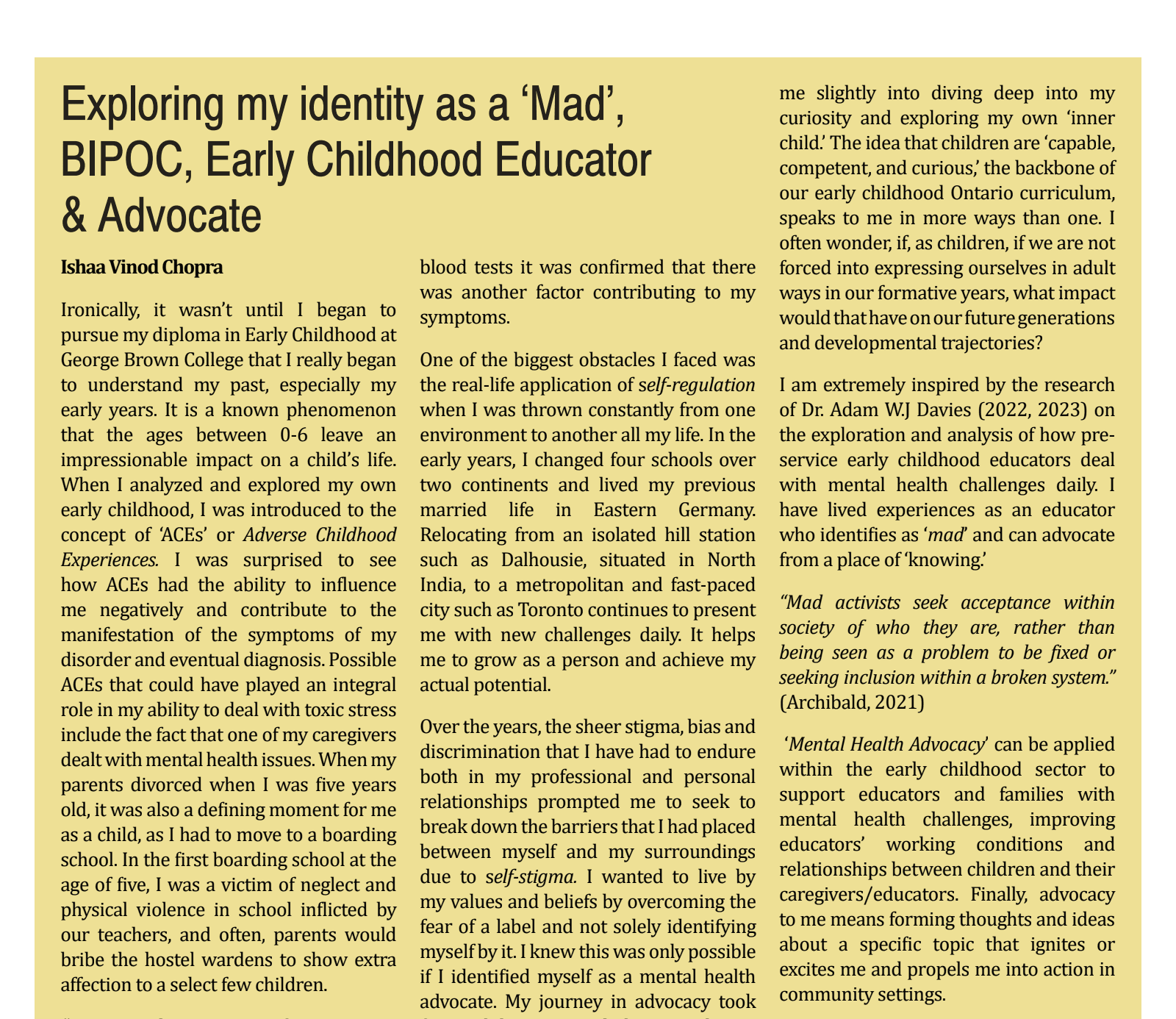
Exploring my identity as a ‘Mad’, BIPOC, Early Childhood Educator & Advocate
Article from Association of Early Childhood Educator’s - AECEO’s - ECE Link Journal on Early Childhood Studies- as part of the section of ‘ECE Voices’ that features student voices. This article was written as a part of a Research Internship under the guidance of Dr. Adam W.J Davies , in collaboration with the AECEO.
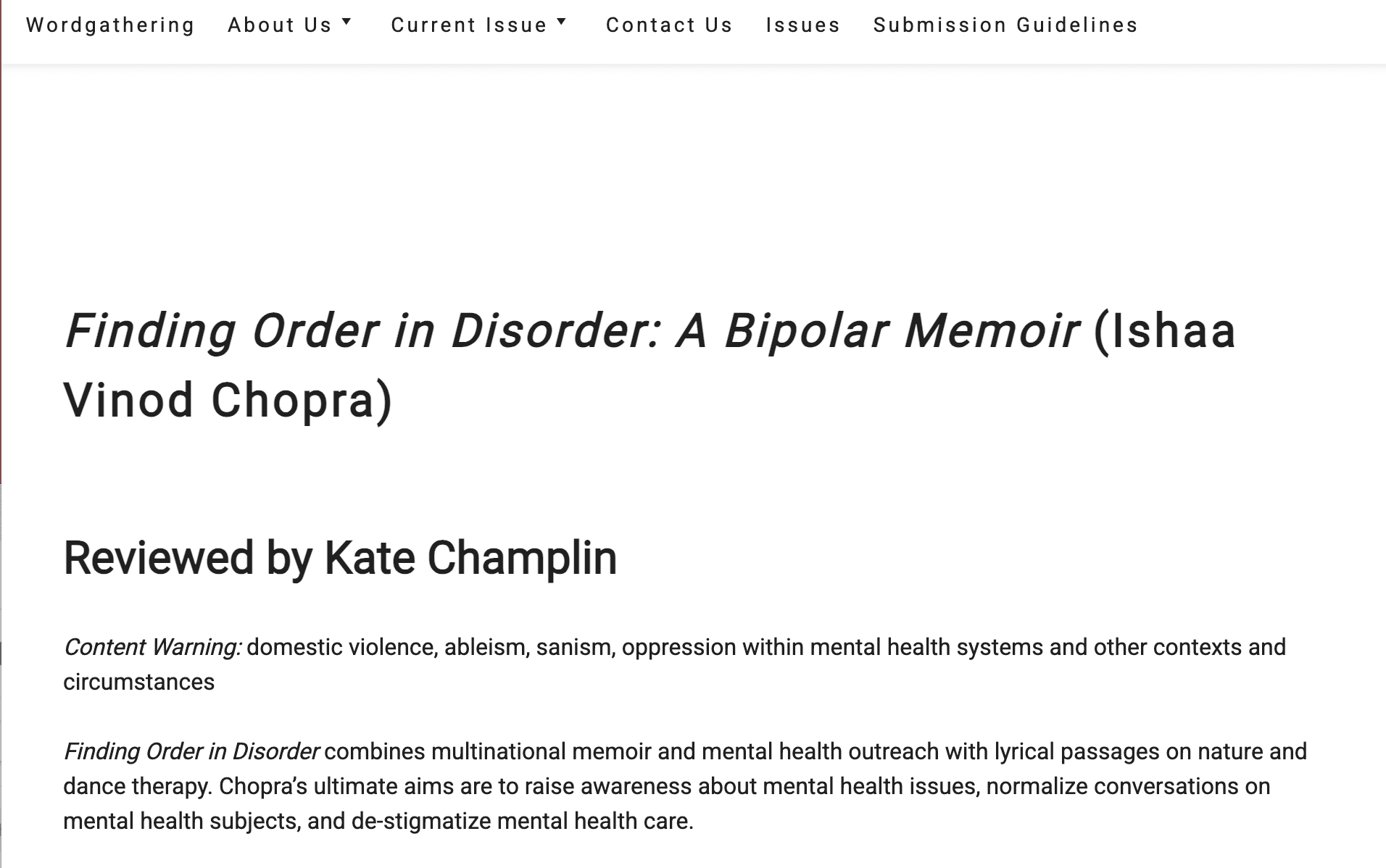
ACADEMIC BOOK REVIEWS
Wordgathering: A Journal of Disability Poetry and Literature
(ISSN: 2690-7089)
Wordgathering: A Journal of Disability Poetry and Literature (ISSN: 2690-7089) is a digital, Open Access journal of disability poetry, literature, and the arts. Submission and biannual publication are free. Authors and other contributors retain copyright to their work. Effective Volume 14, Issue 2 (June 2020), work is published here under the Creative Commons Attribution-NonCommercial-NoDerivatives 4.0 International license. This arrangement is made possible by generous support from the Office of Interdisciplinary Programs and Outreach at the Burton Blatt Institute (housed in the College of Law at Syracuse University) and the Syracuse University Libraries.
About the Reviewer
Kate Champlin (she/her) is a late-deafened adult and a graduate of Ball State University (Indiana). She currently works as a writing tutor and as a contract worker for BK International Education Consultancy, a company whose aim is to normalize the success of underserved students.
ACADEMIC BOOK REVIEWS
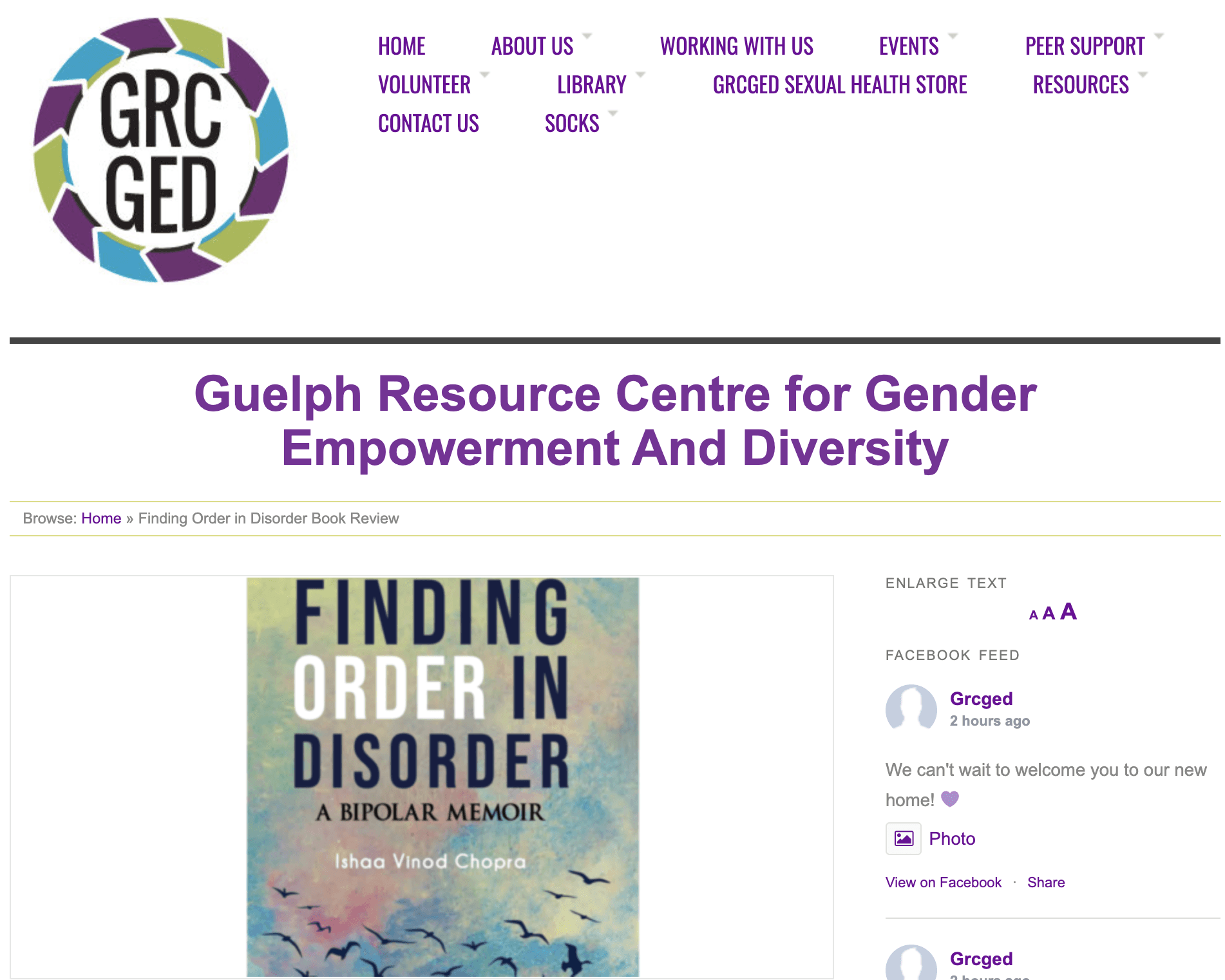
Guelph Resource Centre for Gender Empowerment And Diversity- GRCGED
Finding Order in Disorder is an introspective and chronologically dissonant memoir that situates bipolar disorder not merely as an individual mental health condition but as a lived experience shaped by intersecting structures of gender, race, class, and socio-cultural expectations. The author describes mania and depression, refusing to pathologize these states as mere illness. Instead, she frames them as complex states of being in a world that demands perpetual coherence, productivity, and emotional stability—traits historically denied to women and other marginalized people.
The memoir functions as both testimony and resistance. It illuminates how the medicalization of women’s emotions mirrors broader systems of control. The author’s experiences with diagnosis and treatment highlight how psychiatric discourse often reproduces gendered hierarchies: women’s pain is doubted, their intensity subdued, and their instability pathologized rather than understood. The text reclaims these narratives, transforming “disorder” into a site of agency, self-discovery and knowledge production. It also aims to shed light on the socio-political context of mental health by contrasting her experiences living in Germany, Canada, and India. The author marginally explores how emotion and mental health are shaped by the different systemic socio-cultural inequities present in each country, and how they highly impact an individual’s relationships and personal life.
By centering the author’s embodied experiences, the narrative situates healing as a transformative process of reclaiming voice, agency, and affective sovereignty. Ishaa’s emphasis on artistic and creative expression could function not merely as a therapeutic practice, but as a mode of epistemic resistance and self-(re)construction.
Although the memoir ambitiously seeks to engage a wide range of complex themes to highlight the multiplicity of lived experience, it would benefit from a more sustained and rigorous interrogation of the intersections among intimate partner violence, romantic relationality, mental health, and broader socio-cultural systems of power. Such an engagement would not only deepen its analytical resonance but also transform the narrative into a more comprehensive and incisive contribution to contemporary feminist literature.
About the Reviewer
Reviewed by Lidia Fourcans -Outreach and Administration Coordinator,
Guelph Resource Centre for Gender Empowerment And Diversity- GRCGED
When the Music Stopped
"During all my years with dance, I had never imagined that there would be a time when I would stop. I did, right after my marriage, which left me shattered." (Chopra, 2025).
In her early twenties, she married into a relationship that became immediately abusive. Chopra spiraled through manic highs, depressive lows, and mixed states—a bipolar episode, with aspects of both. She walked through the process of leaving the relationship and healing from its effects and the awakened bipolar symptoms.
Still, the scars were deep. At times, dancing with male dancers amplified symptoms, and she feared that dance itself would be a trigger.
Dancing Again
“Dance is like meditation, where the dancer is free of all worldly thoughts and transcends into the universe. The world of a dancer doesn't have any notion of abnormality or normality in it." (Chopra, 2025).
Her story is not just one of mental health recovery; it is also about self-acceptance. And, just like the show introduction, dance was part of that. Chopra dove deep, engaging with treatment, leaning into family support, and reintroducing her creativity
She writes, "Self-love and acceptance are for me of the utmost importance today. I realize when the world is against you, the only person really rooting for you is yourself; and when the world is with you, the only person you have with you is, again, yourself." (Chopra, 2025).
About the Reviewer
Reviewed by Jennifer Gerlach- Contributor- Psychology Today
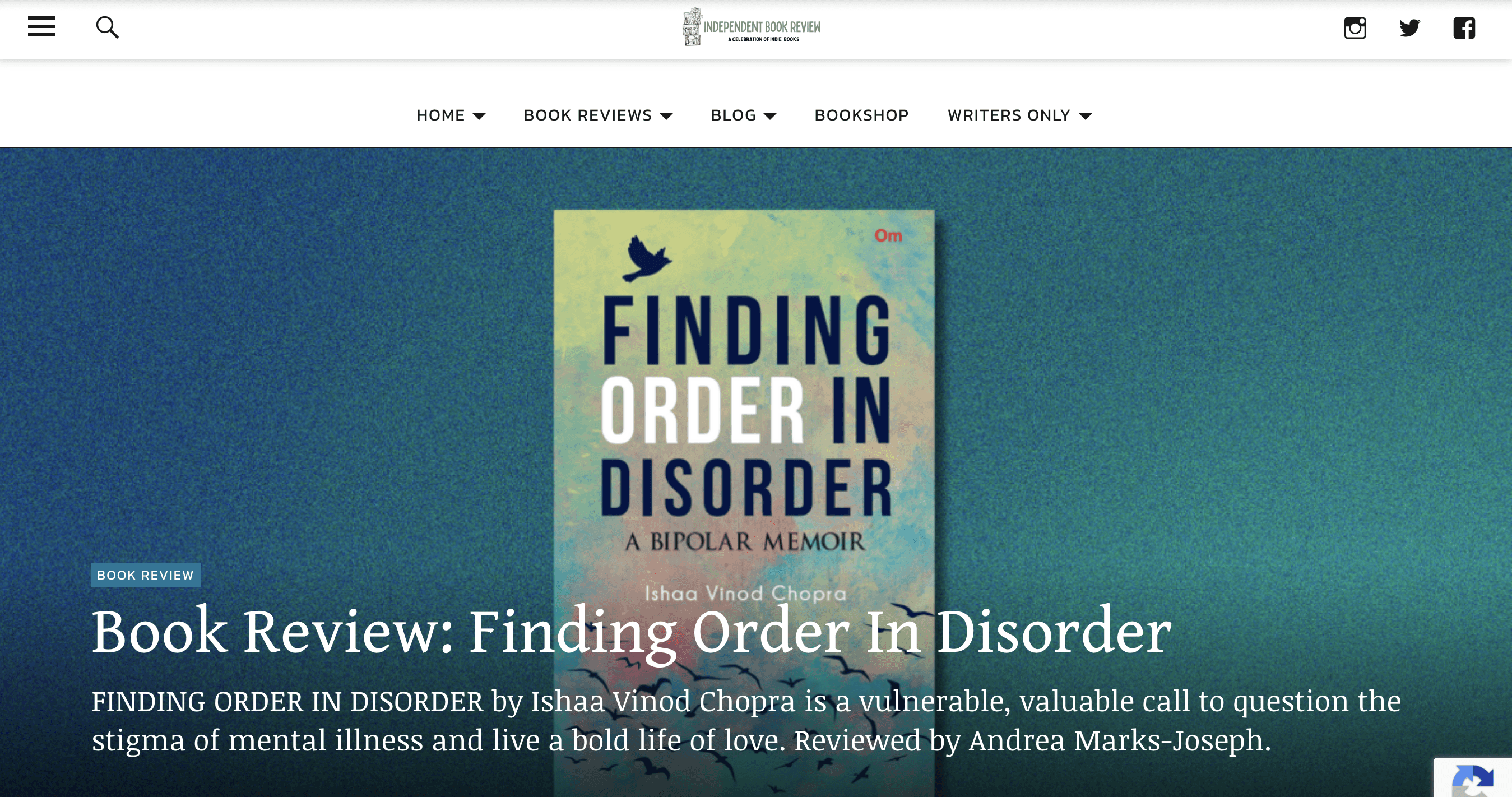
Finding Order in Disorder
Toronto, Ontario
Email findingorderindisorder@gmail.com
Copyright @2025 Finding Order In Disorder